top of page
%20.jpg)
Shockwave Therapy
A non-invasive treatment used for persistent tendon and soft-tissue pain.
Utilises high-energy acoustic waves to stimulate healing in musculoskeletal conditions.
These waves increase local blood flow, trigger cellular repair processes, and stimulate the release of growth factors that support tissue regeneration.
At a biological level, shockwaves promote mechanotransduction—the conversion of mechanical energy into cellular signals—helping reduce pain, break down abnormal tissue, and encourage the body’s natural healing response over time.
By promoting circulation and cellular regeneration, shockwave therapy can speed up recovery and decrease inflammation. This cutting-edge technique has increasingly become utilised in the healthcare field due to its effectiveness and low risk of side effects.
Conditions treated
It is frequently employed to relieve pain and enhance mobility in areas impacted by persistent problems such as tendinopathy, plantar fasciitis, and various soft tissue injuries.
MSK conditions treated with radial shockwave therapy include:
-
Tendinopathies (Achilles, patellar, rotator cuff)
-
Plantar fasciitis
-
Lateral & medial epicondylitis (tennis/golfer’s elbow)
-
Calcific tendinitis (shoulder)
-
Myofascial pain & trigger points
-
Chronic muscle strains
-
Greater trochanteric pain syndrome
-
Shin splints (MTSS)
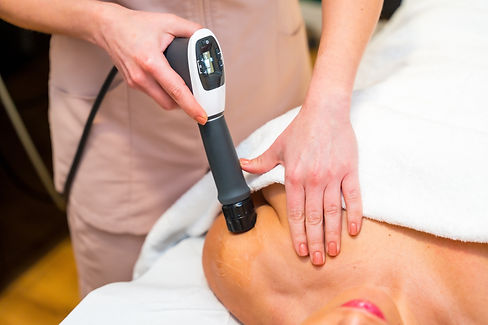

What to expect from shockwave treatment.
Treatment is applied using a water-based, non-medicated, and hypoallergenic conducting gel.
During treatment, you’ll feel rapid tapping or pulsing sensations on the skin. This can feel uncomfortable but is usually tolerable, and intensity is adjusted to your comfort level. Some areas may feel more sensitive, especially over injured tissue.
Each shockwave application typically lasts 5–10 minutes.
After treatment, it’s normal to have temporary soreness, redness, or mild swelling for 24–48 hours—similar to post-exercise soreness.
Most patients return to pre-treatment activities the same day, and improvement is usually gradual over several sessions rather than immediate.
Shockwave works best when combined with rehab exercises.
The shockwave helps stimulate healing and reduce pain, while rehab exercises strengthen the tissue and teach it to tolerate load again. Using both together can lead to better, longer-lasting results than shockwave or exercise alone.
Shockwave is available at an additional £15 per session to standard physiotherapy follow up care (£65 total 30 mins). Typically between 3-6 sessions of shockwave are required.
bottom of page